
Never miss new content!
Subscribe for the latest updates to our blog and Youtube channel.


FIRE isn't just about hitting a number. It's about designing a life you don't need to escape from—values, taxes, identity, and all the pieces in between.

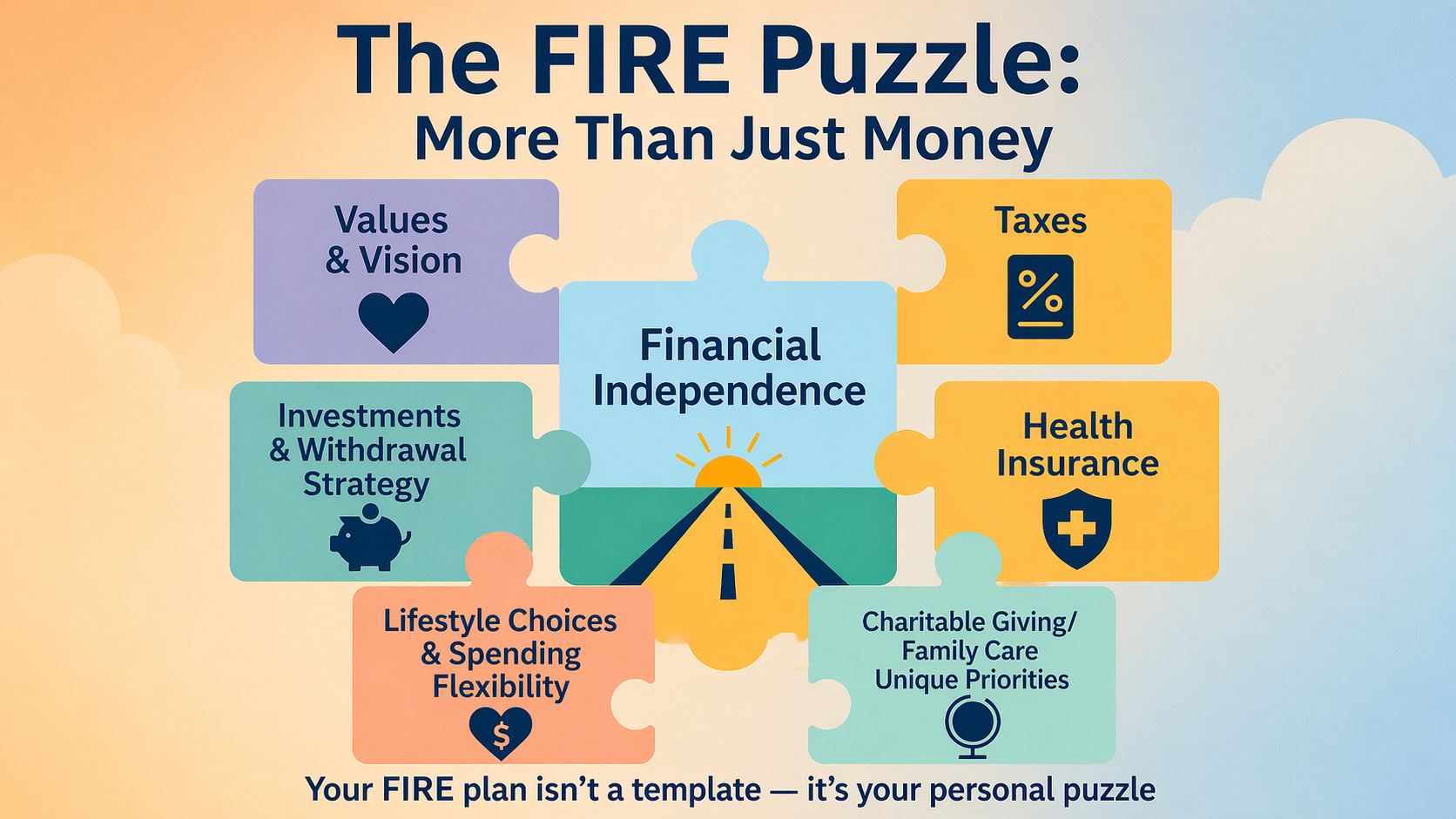
FIRE, or Financial Independence, Retire Early, sounds straightforward: save, invest, retire early, live happily ever after.
But when someone sits across from me, maybe a professional at 38 with a complex compensation package, or someone burned out after years of high performance and says, “I want to retire at 45,” what follows isn't a single calculation.
It's a creative, evolving process. More like solving a complex jigsaw puzzle than plugging numbers into a spreadsheet.
Because here's what the FIRE blogs won't tell you: your well-built portfolio might not feel like “enough” if you haven't figured out who you'll be without the structure of work. And your perfectly optimized withdrawal strategy means nothing if you haven't thought through taxes, healthcare, or what happens when markets don't cooperate.
Each person's vision of freedom is unique.
And the pieces of the puzzle — investments, taxes, health insurance, lifestyle choices, and deeply personal values — must fit together to reveal the life you truly want.
Every puzzle starts by finding the corners — the boundaries that define the picture.
In FIRE planning, those corners are your answers to questions like:
These answers aren't financial; they're about lifestyle, purpose, and values. And without them, even the most optimized portfolio won't feel like “enough.”
Next come the central pieces: the financial mechanics.
Accumulation phase:
Decumulation phase:
This is where FIRE plans differ most: some aim to live entirely off investments, while others blend part-time work, rental income, or small business ventures.
If you're in a high-growth career — especially in tech, startups, or companies with equity compensation — you have unique puzzle pieces:
Equity compensation:
Concentrated wealth:
The irony of success:
This is where FIRE planning becomes deeply personal. Your puzzle includes pieces that don't fit the standard formulas.
Taxes and health insurance often surprise people as being the hardest part of FIRE.
Taxes:
Health insurance:
These “edge pieces” don't always get headlines, but they can shape the entire plan.
No two FIRE puzzles are identical because each client's lifestyle choices color the picture:
Beyond money, the biggest question often is: “Who will I be when I'm no longer defined by my job?”
FIRE isn't a one-and-done calculation. Laws change, markets fluctuate, and — most importantly — people change.
A financial planner's role isn't just to build the first version of the plan, but to keep revisiting it: adding new puzzle pieces, reshaping the picture when life changes, and ensuring it still matches your evolving vision.
Ultimately, FIRE isn't about stopping work early. It's about living deliberately — free to choose how you spend your days.
After years of intense project cycles, Ananya didn't want to stop working forever — she wanted the freedom to take extended breaks between roles. Her puzzle included building a cash runway for flexibility, strategically managing taxes during lower-income years, and navigating health insurance when she wasn't employed full-time.
They hit their financial target but dreamed of splitting time between the US and abroad. Their puzzle required understanding tax implications of international living, managing currency risk, securing healthcare across borders, and designing a lifestyle that felt like freedom — not just relocation.
Leo's spreadsheet said he was ready to retire. But emotionally, he wasn't. His puzzle wasn't financial — it was about purpose. We built a glide path: part-time consulting to stay engaged, volunteer work that felt meaningful, and a spending plan that let him ease into a new chapter rather than jumping off a cliff. Two years later, he's found what he was really seeking.
Financial independence isn't a single picture everyone copies. It's a unique, living puzzle that reflects your values, lifestyle, and the risks you're willing to take.
If you're thinking about FIRE, start by asking:
The math is often the easy part. The hard part is designing a life you don't need to escape from.
If you'd like help assembling your own puzzle — especially if your financial picture includes equity compensation, tax complexity, or questions the FIRE blogs don't answer — I'd be glad to guide you. Schedule a free consultation today.
Take the first step toward financial independence with a free consultation. We'll discuss your goals and how our process can help you achieve them.
.svg)