
Never miss new content!
Subscribe for the latest updates to our blog and Youtube channel.


RSUs get most of the attention, but they're not the only kind of equity you might encounter. Here's a landscape view of the other types of equity compensation you're likely to encounter, and how to start thinking about planning around them.

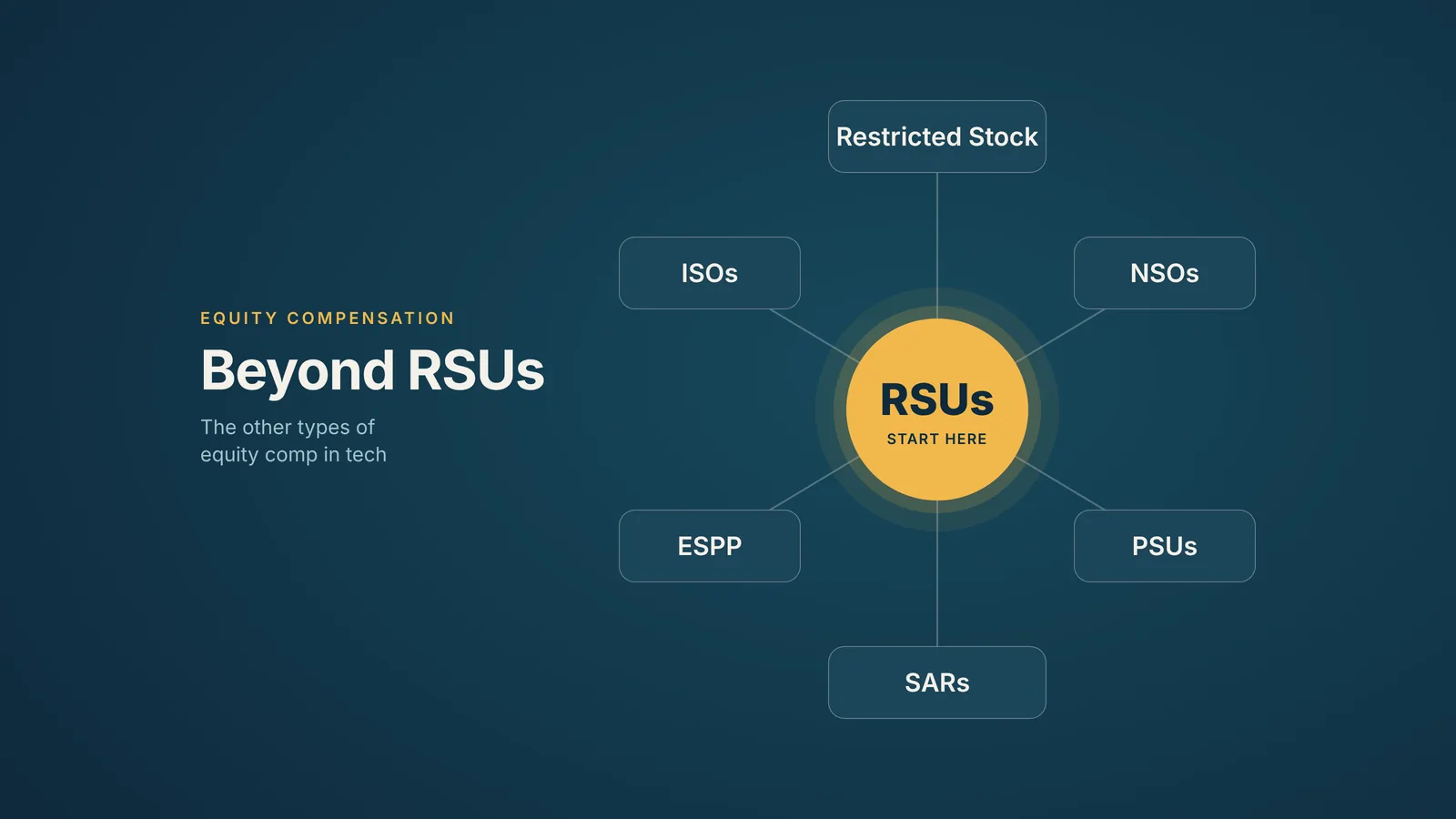
For most tech professionals, RSUs are the equity vehicle that gets talked about most, and for good reason. But many equity packages don't stop there. There are several other types of equity compensation, and depending on your company's stage, your role, and when you joined, your package might include Restricted Stock, Incentive Stock Options (ISOs), Non-Qualified Stock Options (NSOs or NQSOs), an Employee Stock Purchase Plan (ESPP), Performance Stock Units (PSUs), or Stock Appreciation Rights (SARs).
Each of these works differently. Each is taxed differently. And each calls for a different kind of planning.
This post is a landscape view, not a deep dive. The goal is to help you recognize what you're holding and how it broadly works. I'll go deeper on some of these in upcoming posts. If you want the deep dive on RSUs specifically, I've written a complete guide to that here.
For now, let's map the terrain.
Here are the main vehicles side by side, with RSUs for reference. Tax timing is federal and simplified, and details vary by plan.
Restricted Stock, sometimes called a Restricted Stock Award or RSA, is easy to confuse with RSUs, but the two are structurally different. With Restricted Stock, you receive actual shares immediately, subject to a vesting schedule and the company's right to repurchase unvested shares if you leave. With RSUs, you receive nothing until the units vest and convert to shares.
That difference matters for taxes. Because you hold actual shares from day one, Restricted Stock opens the door to an 83(b) election, filed within 30 days of grant. It lets you pay ordinary income tax on the (often very low) value of the stock at grant, rather than as each portion vests. It's a decision with real trade-offs, since you'd be paying tax on shares that could still lose value, and whether it makes sense depends heavily on your situation.
You'll most often see Restricted Stock at very early-stage companies, as founder equity or in grants to some of the earliest employees, when share values are still low enough to keep the tax bill at grant manageable.
ISOs give you the right, not the obligation, to purchase company shares at a fixed price (the strike price) for a set period, typically ten years from grant. The appeal is favorable tax treatment: if you meet specific holding requirements, the gain on sale can qualify for long-term capital gains rates rather than ordinary income rates.
The complication is the Alternative Minimum Tax, or AMT. Exercising ISOs while the stock has appreciated can trigger AMT liability even though you haven't sold anything and have no sale proceeds to pay the tax with. This is one of the more consequential planning decisions in equity compensation, and it deserves real modeling before you exercise, not a rule of thumb. The IRS instructions for Form 6251 show how the ISO spread enters the AMT calculation. The 2026 AMT changes (a lower income level where the exemption starts to phase out, and a faster phase-out after that) make ISO planning more consequential still, and I'll take that on in the upcoming ISO and AMT post.
ISOs are common at earlier-stage private companies, often for employees who joined before an RSU program was in place, and they can only be granted to employees, not contractors or board members. If you hold ISOs and leave the company, the post-termination exercise window (commonly 90 days, though plans vary) becomes a decision of its own. My tech layoff financial guide looks at how to think it through.
NSOs work mechanically like ISOs (a fixed strike price, an exercise window) but without the preferential tax treatment. When you exercise, the spread between the strike price and the current fair market value is taxed immediately as ordinary income, regardless of how long you hold the shares afterward. The IRS overview of stock options covers how both statutory and non-statutory options are taxed.
Companies grant NSOs for a few reasons: they can go to non-employees like contractors or board members, and IRS rules cap how much ISO value can become exercisable in a year, so larger grants often include an NSO component by necessity. The tax treatment is more straightforward than ISOs, but that doesn't make the exercise decision simple. It still involves real cash outlay and a real bet on the company's future value.
An ESPP lets you buy company stock, usually through payroll deductions, at a discount to market price, commonly 15%. Many plans also include a lookback provision, which lets you buy at a discount to whichever is lower: the stock price at the start of the offering period or the price at the end. Combined, the discount and lookback can create a meaningfully favorable purchase price.
The tax treatment turns on how long you hold the shares. The rules below apply to Section 423 plans, sometimes called qualified ESPPs. A sale is a qualifying disposition only if you've held the shares for at least two years from the start of the offering period and at least one year from the purchase date. A sale that misses either one is a disqualifying disposition. Even a qualifying disposition leaves part of your gain taxed as ordinary income, so holding longer can improve the tax treatment without removing that piece. I'll walk through the mechanics in an upcoming ESPP post.
Whether to hold for a qualifying disposition or sell sooner depends on your appetite for concentration risk, and reasonable people land in different places on that trade-off. ESPPs are common at public tech companies and are one of the more accessible ways to build an equity stake outside of grants.
PSUs look similar to RSUs on the surface: they convert to actual shares once vesting conditions are met. The difference is what those conditions are. Rather than vesting purely on tenure, PSU vesting is tied to performance metrics, which might be company financial targets, individual goals, or the stock's performance relative to a peer index. Depending on how those metrics land, your actual payout might be anywhere from zero to well above your target grant, often up to 200%.
That variability is the planning wrinkle worth naming. Where time-based RSUs let you reasonably project a vesting value, PSUs ask you to plan around a number that isn't fixed until the performance period closes. It's worth understanding your specific plan's metrics and payout curve rather than assuming your PSUs will land at target.
PSUs increasingly appear as a layer on top of time-based RSUs at larger, established public tech companies, particularly for more senior roles.
SARs give you the right to the appreciation in a company's stock value over a set period, without requiring you to purchase anything. When you exercise, you receive the increase in value, in cash or shares depending on the plan. Because there's no purchase requirement, SARs avoid the cash outlay of exercising options, and cash-settled versions avoid issuing new shares altogether.
A close relative worth a brief mention is phantom stock, which mimics stock ownership and pays out based on the value of the underlying shares but never involves actual equity. Phantom stock shows up most often at private companies that want to offer equity-like incentives without expanding the cap table. Stock-settled SARs, on the other hand, appear at public companies too.
A few principles apply regardless of which of these vehicles you're holding.
Know what you actually have before you plan around it. The specifics of your grant agreement, vesting schedule, and plan documents matter more than general rules of thumb. Two people who both say they have "options" might be looking at very different tax outcomes.
Concentration risk builds quietly. Equity compensation of any kind ties more of your financial life to a single company's fortunes, on top of the paycheck that already comes from it. It's worth periodically asking how much of your net worth is tied to your employer, whichever vehicle it's held in.
Exercise and sale decisions deserve real modeling, not instinct. This is especially true for ISOs and AMT exposure, but it applies more broadly. A decision that looks obvious in isolation can change once your full tax picture for the year is in view.
Timing across multiple vehicles compounds. If you hold several types of equity at once, decisions about one can affect the tax consequences of another within the same year. Planning works best when it looks at the whole picture rather than one grant at a time.
None of this points to a single right answer. The right approach depends on your risk tolerance, your tax picture, and what you're trying to build toward. What matters is deciding deliberately rather than by default.
Equity compensation rewards people who understand what they're holding. For many people, RSUs are the whole story, and that's perfectly fine. But if your package now or down the road includes any of the other types of equity compensation covered here, each comes with its own mechanics and planning questions.
I'll be going deeper in upcoming posts on three of them: ISOs and the AMT, ESPPs and their tax treatment, and NSOs. In the meantime, if you'd like help thinking through what you're currently holding, book a free consultation and we can map it out together.
Take the first step toward financial independence with a free consultation. We'll discuss your goals and how our process can help you achieve them.
